What actually happens when an advertiser decides to show an ad on a smart TV? It's a real-time dance of technology with its own complexities. While CTV bidding follows many of the standard procedures of any real-time bidding, it has more considerations around frequency, timing, cost, audience targeting, and the other trappings that come with placing an ad slot on the big screen.
Let's pull back the curtain and explore the journey of a CTV ad bid, from the initial bid request to the moment it appears on a shopper’s screen. We’ll walk through how advertisers optimize bids to reach the right audience and stay on track with their campaign goals.
The journey of a CTV ad bid
Knowing how to bid for CTV first starts with knowing how the bidding process works.
This journey largely follows the familiar real-time bidding protocol, but with some crucial CTV-specific nuances:
Step 1: The ad request is born 👶
When an ad break is imminent, the publisher (e.g., Roku, Hulu, Samsung TV Plus) sends out an ad request to various ad exchanges. This request signals that an ad slot is available.
CTV ad requests have fewer available signals than traditional display ads, so bids for space are competitive. Most streaming platforms will have a handful of ad slots for an episode, and some ad slots are reserved for direct sell obligations, leaving only a handful to programmatic bidding.
For instance, if you were watching The Last of Us on HBO Max, the service averages six minutes of ads per hour. That’s precious space on a coveted series!
And unlike display bids, cookies aren’t the reigning signal to determine the audience.
Key signals for CTV
What is sent with the bid request to find matching profiles?
Device ID: These are paramount in the CTV world — they help third parties like Experian translate a device ID to a cookie, email, Ramp ID, or other audience profiles. The device ID helps identify the specific CTV device (Roku, Samsung TV, etc.),
IP address: The IP address helps differentiate real human traffic from data centers or automated sources, ensuring the impression is legitimate.
User agent: This identifies the device's operating system, further confirming the device type and preventing mobile phone impressions from being mistaken for higher-priced CTV inventory.
App information: The specific streaming app (e.g., Tubi, Plex) is also included.
These are the minimum requirements. Some CTV publishers may send additional information about content, genre, maximum ad length, whether the content is child-friendly, and so on.
Step 2: Ad exchanges evaluate the bid 🤔
Once the ad request reaches the exchanges, many advertisers simultaneously evaluate it to determine if they want to bid — and this all happens in the blink of an eye.
This is where data plays a critical role. Ad exchanges will evaluate the targeting criteria, bid amount, and relevance to the CTV viewer. And thus, the winning bid is crowned.
Step 3: The winning bid is chosen 👑
The decision of which ad wins is based on a combination of factors:
Audience match: Does the ad's target audience align with the user profile derived from the device ID and other available signals?
Campaign pacing: Is a campaign pacing behind and needs to deliver more impressions quickly?
Price requirements: Does the bid meet the advertiser's set price thresholds?
Publisher ad break patterns: Publishers have pre-determined ad break patterns (e.g., two pre-roll ads, then a mid-roll break with two to six ads). Only available "open market" inventory is surfaced to exchanges.
At the end of the day, the highest bid wins. The ad exchange, often within milliseconds, determines the winning bid based on these criteria, and the chosen ad is then prepared for delivery.
CTV is the single malt scotch whiskey of ads because there's less of it and it's a lot more expensive. That means the stakes are higher for advertisers.
Here’s how you get ahead of the competition by preparing and optimizing your CTV bids correctly.
Planning and preparing bids
To start, go with broad audience targeting. For example, if you're looking for men who earn $90,000+ who are in the market for a new SUV, let that targeting find the user by going broad first and niching down.
Layering on too many constraints too early (e.g., "only after 8 PM," "only on drama movies," "only on Hulu") can severely limit reach. You might miss potential customers who fit the core audience but watch different content at different times. Start wide and then go narrow, observing the effect of each new constraint.
While direct content-specific targeting (like "cooking shows") might not be visible at the bidding process level, advertisers can segment bids by "deal" (e.g., bidding only on Tubi or Plex deals) and then qualify those bids based on user attributes derived from data partners like Experian.
This data, especially for OEMs like Roku or subscriber services like Hulu, can be rich with demographics, purchase history, and other identifying factors.
Ad optimization in CTV
While optimizing a CTV ad follows most conventional best practices, there are a few constraints specific to CTV optimization. These are what you’ll need to watch for:
Frequency capping
Unlike display ads where multiple ads on a single page might be acceptable, CTV needs a more measured approach. The impact and attention for CTV ads are higher — CTV ad attention rose to 51.5% in Q1 2024.
Advertisers aim for just a few CTV ads a day for each household rather than more than a display ad bombardment. Over-serving ads can lead to "brand recall" at the cost of "positive sentiment," meaning viewers remember the brand but dislike it due to excessive exposure. The sweet spot for brand recall and positive sentiment is typically 3–10 ads per household within a month.
Audience overlap controls
With the right platform, you can control which ad groups will see CTV ads. AdRoll ad groups are containers within your campaign to serve different ad sets to different audience segments with custom schedules, content categories, and keywords.
If you opt for a contextual targeting campaign, you can choose from 90+ CTV curated content categories to showcase your CTV ads during programming that your ideal customer is interested in. It’s an effective method attract new customers who are watching programs that align with your brand and products.
The device graph technology we use to power CTV campaigns can map multiple devices to the same household to prevent an ad being over-delivered to a viewer.
Creative specs
The good news for creative teams is that CTV ad specs are relatively uniform. All TVs have an aspect ratio ofare at least 16x9, so adherence to minimum publisher specs for user experience is key.
While some larger publishers may flag low-quality or poorly configured videos, there's flexibility. Even repurposing social video (e.g., 9x16) onto a 16x9 skin with embellishments like QR codes can be effective. This makes optimizing creative for CTV easier than it first appears.
What happens after a win: Ad delivery and metrics
Winning a bid is the first step to winning over a customer. The next crucial phase is the delivery of the ad and how you analyze its performance.
Ad delivery and placement
Here’s how a streaming platform ensures your CTV ad is delivered on time in quality resolution:
Most streaming platforms use server-side ad insertion SSAI to prevent buffering. Instead of fetching ads in real-time during an ad break, the system requests all ads at once, often when the content first starts. These ads are then downloaded and "baked" into a new, single stream of content with the ads included.
Similar to how video quality adjusts to internet speed on web, SSAI allows ads to dynamically downgrade or upgrade in quality, ensuring no buffering between content and ads. This is critical for live events, where missing a couple of seconds due to an ad loading delay makes the viewer fall behind.
Because ads can be pre-fetched and inserted long before they are actually played (sometimes hours in advance), there can be instances where a bid wins but the ad never results in an impression — for instance, if the user stops watching before the ad break. Ad platforms need to account for this fall-off rate when reporting delivery to you.
Interpreting and using CTV performance metrics
The primary metrics you can track to understand how your CTV ad bids are performing are reach and frequency.
While conversions and site visits are important, the core metric for CTV is reach – getting the ad to the most amount of people within the target audience without over-serving. CTV reach increases brand recall and favorability, and the frequency capping prevents viewers from hitting a point where they’re annoyed with your ad.
Once you’ve hit a comfortable balance between reach and frequency, you start to see positive responses in other metrics, like:
Conversions
Site visits
Purchases
Display engagement and interaction
The feedback loop for refining CTV campaigns
Once you’ve run your first CTV campaign, you’ll enter a feedback loop. If a campaign is struggling to spend, it might indicate overly constrained targeting. If frequency is climbing too high, the audience might be too small, and the campaign is repeatedly serving ads to the same few individuals.
Ultimately, the goal is to find that sweet spot between maximizing reach and maintaining a healthy frequency cap, ensuring the ads resonate positively with viewers. The power of CTV lies in its ability to efficiently deliver ads to engaged audiences, wherever and whenever they're watching.
AdRoll has built a CTV offering that lets you run, measure, and optimize CTV campaigns. We know who your next CTV programmatic partner is: Give AdRoll a try!
Frequently Asked Questions
What is a good strategy to optimize for CTV campaigns?
The most effective strategy is to balance brand awareness with performance-driven tactics in a full-funnel approach. We talk more about this in our blog post on full-funnel strategies for CTV.
For awareness: Use broader targeting (e.g., genre or interest-based) and longer 30-second spots to maximize reach and brand recall.
For performance: Use your own customer lists, first-party data, and lookalike modeling to find and retarget high-intent viewers.
To optimize both, shift budget in real-time toward high-performing supply paths (specific apps or networks) and refresh your creative assets regularly to maintain a high Completed View Rate (CVR).
What is a good frequency for CTV?
In 2026, the industry benchmark for optimal frequency is 4–6 exposures per viewer. However, this is going to vary based on your campaign goals (brand awareness vs. performance) and industry. For instance, high-consideration products(like cars or insurance may require a higher frequency to drive action, while simple impulse buys perform better with lower frequency.
It's key to avoid ad fatigue. Once a household sees the same ad more than 10 times a week, ad fatigue can lead to negative brand sentiment.
How does frequency capping improve CTV campaign performance?
Frequency capping prevents oversaturation and ad fatigue. With frequency capping, your budget isn't wasted on the same small group of viewers. It improves performance by.
For example, by stopping delivery to a household after 5 views, your budget is freed up to reach a new, fresh household. You can also increase the mathematical probability of a conversion by spreading impressions across more potential customers rather than hammering the same ones.
How do I track conversions for CTV ads?
Since CTV ads are mostly non-clickable, tracking relies on cross-channel attribution. Here are the metrics you can track with a platform like AdRoll:
Performance
Video Engagement
Conversion
Spend
Impressions
Daily Device Frequency
CPM
Video Completion Rate
Video Views to 25%
Video Views to 50%
Video Views to 75%
Video Views to 100%
Conversions
CPA
VTC
VTC Rate
Attributed Revenue
View-Attributed Revenue
ROAS
View ROAS
Influenced Conversions
Influenced Revenue
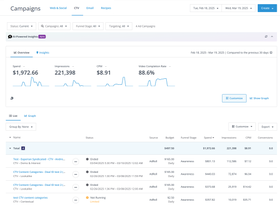
Our dashboard can help you track and manage your campaign in real time.
CTV conversion tracking can show lower numbers compared to web campaigns because they don't use traditional cookie-based tracking methods, and measurement techniques differ from standard web campaign tracking.
You can expect reduced conversion numbers for CTV campaigns and focus on building brand awareness and engagement. This is an industry-standard limitation for connected TV advertising.