We Run Sales-Led Marketing. So Why Are We Running CTV?
The case for testing CTV is straightforward: same targeting data as existing campaigns, premium placement, and a channel where your audience is spending more time.
Read More

In 2026, if you aren’t already in a consumer or B2B buyer’s consideration set as they prepare to buy, it’s too late.
Your advertising strategy needs to run across a variety of channels to reach customers at the right place and the right time — more relevant touchpoints means more likelihood a buyer will recall your brand. Touchpoints are not limited to personal and shared devices inside the four walls of the home.
Digital out-of-home (DOOH) should be part of your 2026 advertising mix. In this guide, we’ll cover what it is, why it works, how it integrates with other ad channels, and how you can get started with your existing programmatic ad budget — no need to invent a whole new ad strategy.
DOOH is an unskippable ad medium that reaches audiences in locations like gyms, offices, and transit hubs.
Programmatic DOOH automates bidding in real-time for ads in physical spaces.
Integrating DOOH increases organic performance across other channels; 73% of consumers take a digital action (like searching or social engagement) after DOOH exposure.
DOOH drives middle funnel intent by leveraging targeted, high-frequency, and contextually relevant messaging in specific locations to build brand consideration and ultimately drive consumer action.
For decades, OOH was the billboard on the highway. It was static, costly (to print, erect and remove physical signage), long-term and difficult to measure. You bought an OOH ad through manual insertions and long-term contracts, and while the real-world impact was high, the lack of flexibility. For example, the ability to run short, highly targeted campaigns to support a seasonal campaign was a barrier for digital-first brands.
The digitization of these out-of-home screens gave us a new way of buying ad slots. This introduced DOOH, or programmatic digital out-of-home. DOOH lets us buy ad placements with real-time bidding, in the same way we buy display and connected TV: through a DSP.
The marketing funnel in 2026 looks a bit different: You may not even interact with a buyer until they’re ready to buy because so much of their consideration is off of traditional websites. DOOH gives you unique touchpoints that reach customers offline.
Not only can you allocate the same programmatic budgets for DOOH, but you can also integrate it into your existing programmatic strategy.
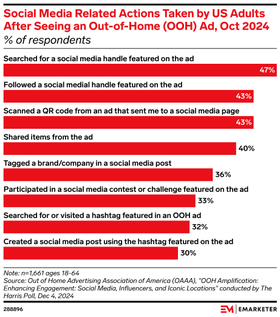
According to EMARKETER, 47% of consumers search for social media handles featured on OOH ads, and 40% share related content online.
Source: EMARKETER
DOOH plays nicely in a multi-channel strategy with CTV, social, display, native, and all your other existing channels to drive shoppers to the purchase page. More on cross-channel collaboration later.
DOOH expands your reach. While a display ad may be 1:1 with a viewer, and a CTV ad will be 1:1 with a household, DOOH is 1:many. DOOH casts a wider net with a louder voice. Additionally, with the increasingly privacy-conscious nature of our world, DOOH offers a less invasive way to reach audiences. Since it targets cohorts and locations rather than tracking personal data, it is inherently more privacy compliant while still being effective.
There is no ad blocker for DOOH. Because of its omnipresent nature, you can’t easily tune out a DOOH ad. And DOOH ads aren’t restricted to roadside billboards and street level inventory; they’re place-based, dynamic screens at gyms, malls, and even bars.
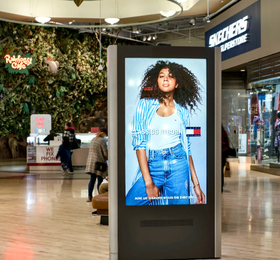
The funnel isn’t so clear-cut in 2026; your DOOH ads will likely be serving multiple funnel stages and audiences at once. But to simplify a complicated customer journey, DOOH ads can bring awareness, nurture intent, and drive conversions — sometimes doing all three simultaneously.
Like CTV, DOOH often gets labelled as TOFU-only. However, programmatic advertising allows the ROI for these channels to be more clearly traced, giving them credit as full-funnel ad channels.
Companies that invest in top-of-funnel DOOH marketing display ads introducing who they are and what they do. These ads have broad reach and will likely be the most visible DOOH ads you will buy, since you’ll use narrower targeting for lower funnel ads.
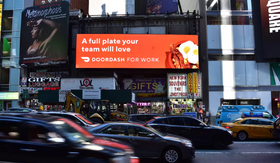
MOFU is where you can redirect audiences to additional channels and resources. DOOH works best in conjunction with existing programmatic channels, so this is a funnel stage where it shines.
DOOH can lead viewers to other channels with QR codes for interactive creative, text prompts for SMS, or simple website URLs. These features ship audiences to your other channels, increasing the touchpoints they have with your brand.
However, since DOOH exposure is often measured in seconds while viewers are on the go, don’t count on QR links or website visits to be your guiding metrics for a DOOH campaign. Some of your audience can convert directly from a DOOH ad, but many more will use it as one of the many touchpoints in their customer journey.
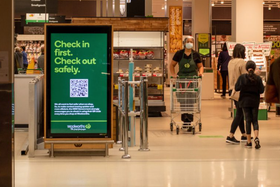
DOOH is perfect at spurring impulse buys. Advertisers use DOOH ads in geotargeted locations to drive sales to a point of purchase.
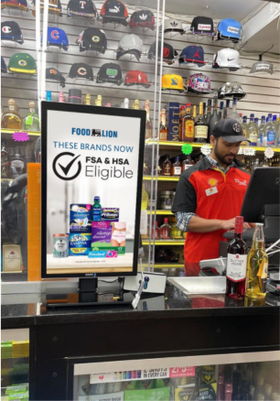
DOOH ads that lead to conversion can include deals, discounts, or info about where customers can go locally to buy the product.
DOOH is also measurable. Advertisers can remove the guesswork with third-party partnerships that measure full-funnel impact.
If you can't measure it, you shouldn't buy it. These are some metrics you can expect for each funnel stage:
Brand Lift Studies (TOFU): Using control vs. exposed groups to measure increases in brand awareness and intent after DOOH ad exposure.
Search Lift (MOFU): Measuring the spike in branded search queries in specific geographic zones where DOOH ads were active.
Foot Traffic Attribution (BOFU): Using anonymized mobile location data to prove DOOH ads drove foot traffic.
These typically require a minimum level of spend and scale to ensure statistical significance. Our team at AdRoll can help you determine when these measurement options make sense — and when delivery and exposure metrics are the right place to start.
We have a quickstart guide on DOOH measurement that shows you how it works. Download the DOOH measurement guide to learn more.
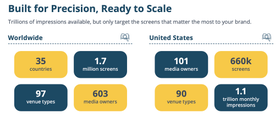
Advertisers in 2026 are thinking about how to stretch ad budgets across their existing channels.
Thankfully, DOOH increases performance across all other channels. Integrating DOOH creates a larger pool of devices that can be retargeted, building up touchpoints before conversion.
Here are some examples of how DOOH interacts with your other 2026 channels:
DOOH + CTV: Run a brand story ad on CTV in a geotargeted location, and then "refresh" that memory with a DOOH ad in the same area.
DOOH + mobile retargeting: Once a user enters the geofence of your DOOH screen, they are added to a mobile retargeting pool for high-frequency follow-up.
DOOH + display: Target screen types in an area your target audience would frequent (such as gyms or malls) while doubling up with interest targeting on display ads.
Choosing an ad platform that can run multiple channels and give you accurate measurement for each is imperative with an increasingly disjointed customer journey. AdRoll helps you run full-funnel, multi-channel campaigns with DOOH included.
For DOOH, we target based on screen-level indexing, meaning we identify screens with a high density of mobile devices that match your targeting criteria.
This results in a custom experience with alignment to customers’ targeting used in other tactics.
This allows us to serve ads only on screens where we have a higher probability of reaching your target audience, reducing wasted impressions on screens that are not as relevant.
As we move through 2026 and beyond, DOOH will only become more integrated into our lives. Think of all the places that didn’t have digital screens ten years ago.
Add another touchpoint to your advertising funnel with your existing programmatic budget — no manual bids required. Talk to our team at AdRoll and get started with a DOOH campaign.
Traditional OOH (Out-of-Home) refers to static physical displays, such as vinyl billboards or printed posters, that remain unchanged for weeks. DOOH (Digital Out-of-Home) uses digital screens (LED/LCD) to display dynamic content.
In 2026, the primary difference is programmatic capability: DOOH allows for real-time bidding and data-led audience targeting. Dynamic triggers can swap creative based on weather, time, or live events.
DOOH measurement is easier than ever. The two big ROI-boosting KPIs for 2026 include:
Foot traffic attribution: Uses anonymized mobile location data to link ad exposure to physical store visits.
Conversions: Form fills or app installs from a QR code or URL included on a DOOH ad.
Brand lift: Survery-based panels with an exposed vs. control group that determine brand recall and favorability.
Search lift: Geographic search volume analysis that measures search volume lift after ad exposure.
In 2026, DOOH is a top strategy for B2B brands to reach hard-to-find decision-makers. By placing ads in place-based networks like office building elevators, medical offices, and airport lounges, B2B marketers can target professionals during their workdays and commutes.
(And P.S., AdRoll ABM can help you!)
Costs vary based on location, screen size, and competition. While large-format digital billboards in premium spots (like Times Square) require higher spend, programmatic DOOH (DOOH) allows for much smaller entries.
Ad platforms will usually allow you to set daily budgets and CPM, making it more accessible than traditional OOH.
Last updated on February 20th, 2026.